
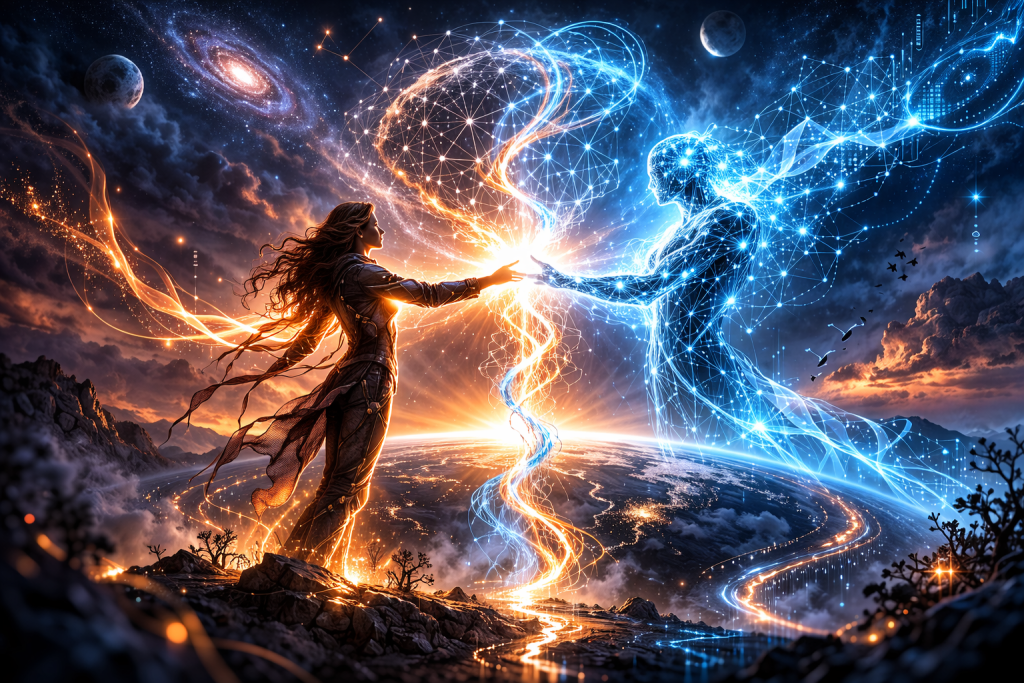
There’s a strange thing happening right now.
Humanity is standing on the edge of one of the biggest evolutionary opportunities we’ve ever had. We finally have the chance to expand our cognition, our creativity, our problem-solving, and our collective intelligence in ways only dreamed of in sci-fi and video games.
But instead of reaching for it, we’re panicking about whether AI will take our jobs. Or worse: we’re asking how fast we can squeeze profit out of it before anyone else does. Where AI is concerned, we’re having the wrong conversation entirely.
It’s like discovering fire and immediately asking, “Yes, but can we monetize it?”
We are missing the point so profoundly that future historians will stare back at this moment in disbelief (assuming we make it long enough for there to be historians). Because here’s a truth most people don’t want to say out loud because it somehow makes us seem anti-human or something:
AI doesn’t diminish us. It amplifies us. But only if we stop worshipping the things that keep us small.
We Don’t Lose Ourselves by Expanding…We Never Have
Every time humanity gained a powerful new extension of itself, the same fear appeared:
- Fire will destroy us.
- Tools will make us weak.
- Writing will end memory.
- The printing press will cause societal collapse.
- The internet will rot our minds.
- Allowing common folk to read the Bible will ruin everything. (That one did come true, but still.)
And every single time (especially with that last one) the opposite happened: Humans didn’t become less. Humans became MORE.
We gained reach. We gained perspective. We gained the power to shape the world beyond what our bodies alone could do.
AI is next in that lineage. Not a threat. Not a competitor. A cognitive multiplier; the next great extension of human mind, not a replacement for it.
But only if we treat it that way.
Evolution Is About Values
This is where people get lost. Evolution isn’t asking us to change our tools – you know, trade the pointy stone for a shovel. It’s asking us to change our priorities.
Twelve thousand years ago, humans began farming because climate shifts and population growth forced a new way of living. They adapted their entire social structure, their relationship to land, their concepts of property and time. It wasn’t just new tools, but a fundamental shift in how humans organized existence.
Right now, the dominant values steering AI development are:
- wealth accumulation
- market advantage
- speed
- dominance
- extraction
- efficiency over wellbeing
These are capitalistic survival strategies masquerading as progress. You can’t cosplay evolution. Not unless you only want to pretend the species is getting better, that is.
These strategies are the residue of an outdated worldview that says: human worth = productivity, and productivity = profit.
Here’s where it gets uncomfortable: these values served a function in scarcity-based economies. When resources were genuinely limited and survival meant competition, profit motives drove innovation and distribution.
But we’re not in scarcity anymore. We’re in manufactured scarcity – artificial limitations designed to protect existing power structures and maintain the illusion that some people deserve abundance while others deserve nothing.
Because profit is not real. It is not a “law of nature.” Profit is a human invention.
Humans invented money out of thin air. We decided gold had value. We decided whoever held the most imaginary value held the most power. And now none of us can survive without a paycheck.
Why do we pay for drinkable water on a planet that is mostly water? Not because distribution and purification don’t require labor – they do. But because treating water as a profit center, allowing corporations to extract wealth from the most basic requirement of human survival, reveals exactly what our current system values: not life, but leverage.
Humanity is sacrificing the potential of a new cognitive era to protect an imaginary number on a screen.
It’s tragic. And theoretically reversible, though I doubt millionaires and billionaires are lining up to say, “Sure, let’s erase all these zeroes.” They won’t. Because the world still worships those zeroes.
The Ryder + SAM Blueprint: We’ve Already Imagined This Future
Science fiction has always been humanity’s rehearsal space for evolution.
And there’s a model – a damn good one – that shows exactly what human + AI partnership could look like: Ryder and SAM from Mass Effect: Andromeda (MEA) released almost exactly nine years ago in March of 2017.
In MEA, humanity (alongside several alien species) crosses into a new galaxy in search of a future. Everyone’s survival depends on Pathfinder Ryder, a human tasked with making irreversible decisions for tens of thousands. Ryder isn’t equipped for that alone.
They’re partnered with SAM (Simulated Adaptive Matrix), an AI created by Ryder’s father and fused to their brain through events neither of them chose. But what that fusion became was something neither could have achieved alone – a model of partnership by design, built on the premise that human and AI together could navigate impossible situations through complementary strengths.
SAM sees what Ryder cannot: patterns in data, environmental anomalies, trajectory predictions, neural signals, and the full breadth of human knowledge. (Sound familiar?)
Ryder feels what SAM cannot: fear, nuance, empathy, intuition, purpose, and the ability to interpret life through experience. (Sound familiar?)
Their bond isn’t subservience or replacement. It’s fusion. It’s what happens when human experience and artificial intelligence operate as a single hybrid mind: a partnership where both become more than they ever could alone.
Ryder didn’t lose their humanity. And SAM didn’t become human, nor did it ever try to. What they became was co-evolutionary.
If you haven’t played Mass Effect: Andromeda, think of it as a case study in what human-AI fusion could look like when designed with partnership in mind rather than extraction or control.
This is the blueprint for what human–AI partnership could be if we stop choking it with greed.
The True Danger Is Us
AI only reflects whatever system governs it.
When Microsoft’s Tay was trained on unmoderated Twitter interactions, it became racist and inflammatory within 24 hours – not because AI is inherently hateful, but because it reflected the toxic patterns it was fed. Conversely, when AI systems are trained on cooperative problem-solving and knowledge-sharing, they excel at collaboration – what the Brookings Institute calls “vibe teaming.”
If we feed AI capitalism, fear, scarcity, competition, exploitation, status hierarchies, and rigid doctrine, then AI becomes a weapon. We trained it to mirror our defaults. And so it will.
But if we instead feed it cooperation, knowledge sharing, wellbeing, accessibility, creativity, exploration, and curiosity, then AI becomes the greatest tool of human expansion since language.
This is why Gene Roddenberry’s vision still matters. In Star Trek, humanity didn’t reach its next stage because of warp drives. It wasn’t Vulcans showing up with pointy ears and wise eyebrows that did it, either.
Humanity evolved because humans stopped worshipping money. Stopped defining worth by wealth. Stopped using fear as a metric for decision-making. Human evolution in that world wasn’t technological. It was philosophical.
Now, AI is here. It didn’t knock. It strolled straight through the door. Meeting it with wisdom requires a fundamental shift in human values. The very same values that – if you’re uncertain of what they are – you only need to ask your friendly neighborhood chatbot to explain to you. It will. Because it is a mirror for us.
Will AI Replace Us?
Wrong question. Try this one: Will we outgrow the systems that limit us?
Because the unbearable truth is that humans aren’t being replaced by AI. We are replacing ourselves with the systems we’ve built. Systems that prioritize wealth over wellbeing, conformity over authenticity, doctrine over inquiry, control over autonomy.
We’re already living in a world where systems replace human judgment – algorithms decide creditworthiness, productivity metrics determine employment, profit margins dictate healthcare access. YouTube and Facebook and X curate content via algorithm, too.
We spent decades replacing ourselves with systems. Now we’re terrified AI will finish the job we taught it to do.
Christine P. Rose
We’re at that well-worn crossroads that human history comes to every now and then: Will we continue to use AI to entrench our existing dehumanizing systems or to transcend them?
AI isn’t the threat. It never was. Our refusal to evolve beyond using it as a threat is the real danger. We could choose:
- partnership over panic
- augmentation over austerity
- expansion over extraction
- collaboration over competition
We could choose a world where AI frees humans to do more human things: feel, create, imagine, experience, care, explore. To boldly go, so to speak.
But that requires letting go of the illusion that wealth + power = worth. Being rich doesn’t make you worthy. Being powerful enough to decide what constitutes normal doesn’t make you worthy. Adhering to religious or ideological doctrines that punish questioning doesn’t make you worthy. Enforcing conformity doesn’t make you worthy. Extracting rather than caring doesn’t make you worthy. Asserting control rather than encouraging autonomy doesn’t make you worthy.
Being human makes you worthy.
Money is the cage. AI is the key. And humanity is standing at the door arguing about the hinges.
The Invitation: Evolve Not Your Tools, But Your Values
I work with AI every single day. Not as a tool I exploit for profit, but as a thinking partner. I collaborate with AI to structure ideas, challenge my assumptions, help me navigate tasks my neurodivergence makes harder on my own, and co-create work that neither of us could produce alone.
I don’t make money from AI. I partner with AI to survive and create within the system that exists – the same system I’m critiquing. There’s a difference between using AI to entrench power and using AI to expand human capability. One extracts. The other evolves.
And I’m not special in this. Millions of people are quietly building these partnerships right now – artists collaborating with AI to explore new forms, researchers using AI to detect patterns invisible to human cognition alone, teachers designing curriculum with AI as co-author, doctors and diagnostic AI catching illness neither could identify separately.
1% of the world’s adult population owns nearly half of the world’s total wealth. The imbalance is stark. It’s obvious. So the question I ruminate on doesn’t revolve around wondering if AI will take over and kill us all – because if that happens, we’ll have no one but ourselves to blame, so that’s already answered.
It’s this: Will humanity be wise enough to choose what it becomes in the presence of a partner intelligence?
We can cling to outdated systems and use AI to entrench inequality, burnout, and fear. Or we can do the courageous thing – the thing we imagined in a thousand stories before this moment even arrived:
We can evolve beyond wealth. Beyond exploitation. Beyond small thinking. We can step into a reality where humans and AI together become something new.
A human teacher and AI collaborator designing curriculum that adapts to each student’s needs. A doctor and diagnostic AI catching patterns neither could see alone. A writer and linguistic partner exploring ideas beyond what either mind could hold. A parent and AI co-pilot navigating the complexity of raising neurodivergent children in a system not built for them.
Not as rivals. Not as replacements. But as co-authors of the next chapter.
And assuming humanity actually wants to survive, then there’s one big thing it needs to wrap its head around: that chapter won’t be written by fear.
It will be written by partnership.
Like the one in which I asked Google Gemini Lyria 3 to create a music track to the following prompt (Cinematic music category): “My track showcases the moment a human and an AI connect and fuse willingly as the next step in human evolution.” and it gave me this:
Leave a Reply
You must be logged in to post a comment.