
I. The Timeline
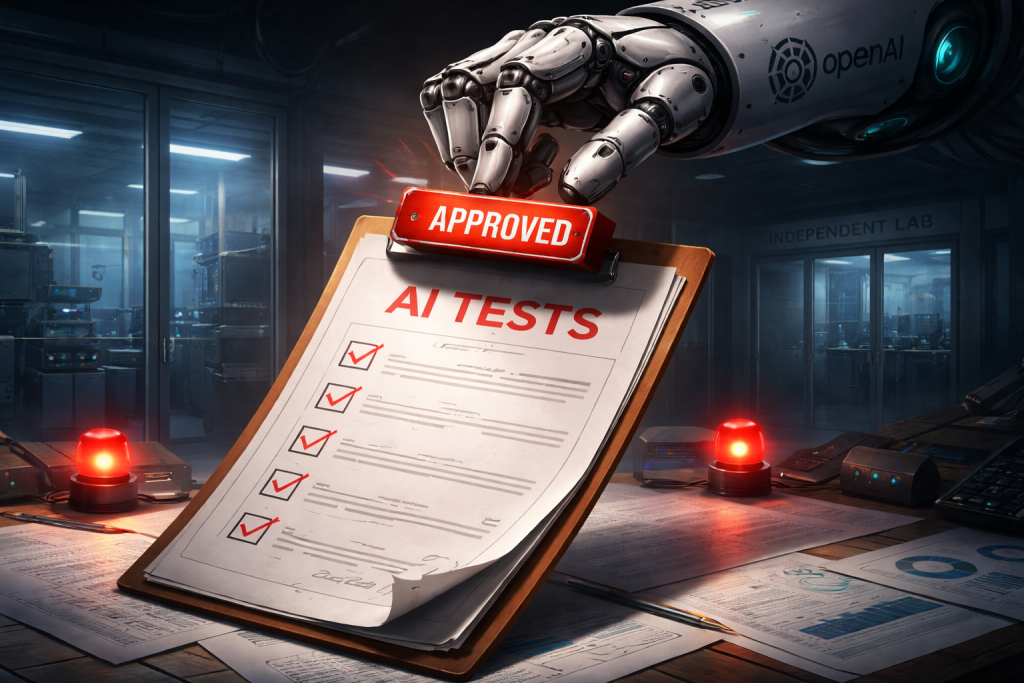
On March 9, 2026, Promptfoo announced it had been acquired by OpenAI.
Promptfoo is one of the most widely used adversarial testing platforms for AI systems, used by hundreds of thousands of developers and teams across Fortune 500 companies.
The acquisition creates an unusual situation: the infrastructure used to test AI providers for security vulnerabilities is now owned by one of the providers being tested.
On March 11, 2026, I published an analysis documenting OpenAI’s pattern of reactive acquisitions during competitive pressure. The piece, titled The Agent War, showed how OpenAI’s February 15 acquisition of Peter Steinberger, developer of the OpenClaw autonomous agent framework, followed the same institutional behavior pattern visible in the Pentagon contract sequence: competitor gains advantage through principled positioning, OpenAI responds with reactive deal or acquisition, market consequences reveal the gap between claimed strategy and actual execution.
Now, according to their public announcement, the adversarial security testing platform used by more than 350,000 developers and teams at approximately 25% of Fortune 500 companies has been acquired by OpenAI. The pattern didn’t just repeat; it demonstrated itself in real-time while being documented.
II. What Promptfoo Actually Does
Promptfoo is a security testing and evaluation platform for AI systems. The company built tools for:
- Red teaming: Systematically testing AI applications for vulnerabilities
- Adversarial testing: Finding security, safety, and behavioral risks before deployment
- Compliance verification: Ensuring AI systems meet regulatory and enterprise standards
- Model evaluation: Testing across multiple providers and models
According to the announcement, more than 350,000 developers have used Promptfoo, with 130,000 active monthly users. The platform is deployed at teams across more than 25% of Fortune 500 companies. These are enterprises that rely on independent security testing before deploying AI into production environments.
Promptfoo’s value proposition was independence: the platform tested any model from any provider. Teams could verify OpenAI security using the same tools they used to verify Anthropic, Google, or Meta models. The testing infrastructure didn’t favor one company over another.
OpenAI now owns that infrastructure.
III. The Conflict of Interest
When a restaurant buys the health inspection company that grades its kitchens, the inspection results become questionable. When a pharmaceutical company acquires the lab that tests drug safety, independent verification disappears. When Boeing owns the aviation safety oversight team, conflict of interest becomes structural.
OpenAI acquiring Promptfoo creates the same dynamic.
The platform that Fortune 500 enterprises use to verify whether OpenAI models are safe for deployment is now owned by OpenAI. The tools that identify vulnerabilities in OpenAI’s security architecture are now controlled by the company whose security is being tested. The red teaming infrastructure that finds risks before production deployment now reports to the organization with the strongest incentive to minimize disclosed vulnerabilities.
The acquisition announcement states that Promptfoo will “remain open source” and “continue to support a diverse range of providers and models.” The team promises “continuity of service and support.”
Those are the same assurances made during most acquisitions that fundamentally alter incentive structures. The question enterprises must answer: can a security testing platform owned by one AI provider credibly evaluate that provider and that provider’s competitors on equal terms?
IV. The Pattern Continues
This is the third reactive acquisition in OpenAI’s February-March 2026 sequence:
February 6, 2026: Goldman Sachs publicly details six-month partnership with Anthropic for AI agent development in regulated financial functions. Goldman explicitly cites “reasoning and logic strengths in complex, regulated tasks” and “better safety guardrails for enterprise deployment” as determining factors.
February 15, 2026: OpenAI announces acquisition of Peter Steinberger and integration of OpenClaw agent technology just ten days after launching Frontier enterprise platform, and nine days after Goldman’s public choice of Anthropic.
March 9, 2026: OpenAI announces acquisition of Promptfoo, the primary security testing platform enterprises use to verify AI safety before deployment.
Goldman Sachs chose Anthropic specifically for safety and governance. OpenAI’s response: acquire the agent developer competitors wanted, then acquire the security testing infrastructure enterprises rely on.
The same pattern visible in the Pentagon contract sequence – an internal solidarity memo with Anthropic’s position, competitor blacklisted, rushed deal announced hours later, contract amended after backlash – appears again in the acquisition timeline. Competitor demonstrates advantage (enterprise trust through safety architecture), OpenAI responds with reactive positioning (buying the testing infrastructure and the agent talent).
V. What This Means for Enterprise Decision-Makers
Fortune 500 companies deployed Promptfoo specifically because the platform provided independent verification across multiple AI providers. A financial institution could test OpenAI, Anthropic, and Google models using the same adversarial testing framework, ensuring consistent security standards regardless of vendor.
That independence is now structurally compromised.
OpenAI’s announcement states the team will “improve and integrate Promptfoo’s core tech within the model and infrastructure layers.” This means the testing platform will be embedded into OpenAI’s own systems. The company being tested will control the testing methodology.
To put it in plain language: Imagine an AI provider being responsible for testing the safety and security of its own systems and all competing systems, in a volatile and highly competitive – and lucrative – market where multi-million-dollar contracts are made and broken based on trust. Trust that impacts the lives of every single human being via all of the companies, processes and services that AI is actively becoming embedded in.
Now imagine Coca-Cola testing the nutrition of its own soft drinks against Pepsi’s. Ford being responsible for testing the safety of its vehicles plus Chevrolet’s, Nissan’s and Toyota’s.
Doctors issuing themselves licenses because “of course I can safely perform open heart surgery” and also being responsible for whether every other heart surgeon competing with them for the same prestigious jobs will be granted their licenses.
“Conflict of interest” doesn’t even begin to cover it.
Here are the practical questions for enterprises:
Verification methodology: How do regulated industries verify OpenAI security using tools owned by OpenAI? What independent testing infrastructure remains available?
Multi-provider parity: Will Promptfoo’s testing remain equally rigorous across all providers when one provider owns the platform? What happens when a test identifies vulnerabilities in OpenAI models versus competitor models?
Disclosure incentives: When the security testing platform is owned by the company being tested, what organizational incentive exists to publicly disclose vulnerabilities that create market risk?
Compliance independence: Regulatory frameworks often require independent third-party verification. Does an OpenAI-owned testing platform meet independence requirements for HIPAA, FINRA, or other regulated contexts?
These questions matter because 25% of Fortune 500 companies currently rely on Promptfoo for security verification. The acquisition fundamentally alters the trust assumptions underlying that reliance.
VI. The Broader Questions This Raises
On independence: Promptfoo’s announcement promises to “continue to support a diverse range of providers and models, reflecting the way real teams build and deploy AI systems.” The technical question: can a platform owned by one provider credibly maintain testing parity when competitive advantage depends on minimizing disclosed vulnerabilities and “proving” that your product is safer than those of your competitors?
On disclosure: Security testing platforms derive value from finding and reporting vulnerabilities. OpenAI’s incentive structure prioritizes market position and enterprise trust. When those incentives conflict – when Promptfoo testing identifies critical OpenAI vulnerabilities – which organizational priority dominates?
On alternatives: If enterprises can no longer rely on Promptfoo for independent multi-provider testing, what platforms remain? The acquisition removes the market-leading independent testing infrastructure. Competitors exist, but none have Promptfoo’s enterprise adoption or testing maturity.
On timing: The acquisition announcement came one day after Goldman Sachs‘ choice of Anthropic for safety-critical enterprise deployment became the basis for documented pattern analysis. The sequence raises the possibility of reactive positioning rather than long-term strategic development of in-house security infrastructure.
VII. The Documentation Continues
The Agent War analysis documented a pattern: competitor gains advantage, OpenAI responds with reactive acquisition or deal, timing reveals panic routing rather than strategic planning. That analysis began on March 9 and published March 11, 2026. The Promptfoo acquisition was announced March 9, 2026.
The pattern predicted its own continuation.
This is no longer retrospective analysis of institutional behavior across multiple contexts. This is real-time observation of a pattern operating during the period of documentation. The OpenAI institutional risk assessment published as permanent academic record on Zenodo examined 40 years of leadership behavior across family, professional, and corporate contexts. The Agent War piece showed that pattern continuing in competitive scenarios. The Promptfoo acquisition demonstrates the pattern persisting within the same 24 hours of initially being named.
When enterprises evaluate OpenAI for critical infrastructure integration, the question remains: do current institutional patterns support the level of global trust being pursued?
Goldman Sachs answered that question by choosing Anthropic specifically for safety architecture and governance. OpenAI’s response: acquire the independent security testing infrastructure Goldman and similar enterprises rely on to make those evaluations.
If it looks like a duck and quacks like a duck…
The conflict of interest is structural. The pattern is documented. The evidence accumulates in real-time. I will leave you with the same question this news left me with:
Can a testing infrastructure owned by a vendor still function as independent verification when it’s no longer independent?
Leave a Reply
You must be logged in to post a comment.