
Security Recommendations for OpenAI: Response to December 2025 ChatGPT Roadmap Query
On December 23, 2025, DANE (@cryps1s) from OpenAI posted the following question to X:
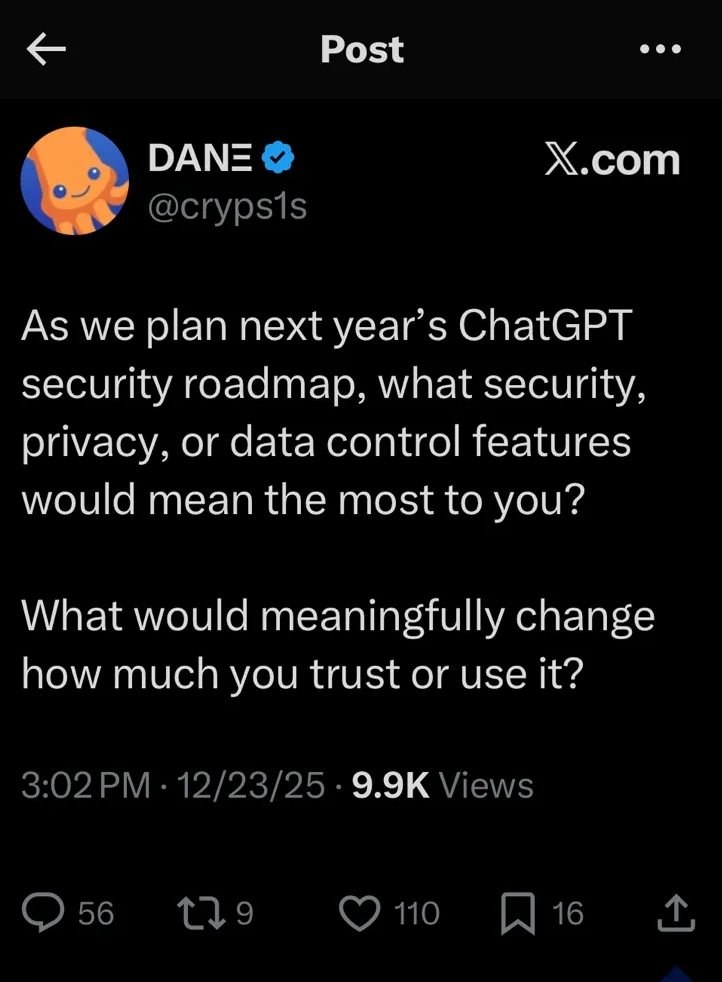
“As we plan next year’s ChatGPT security roadmap, what security, privacy, or data control features would mean the most to you? What would meaningfully change how much you trust or use it?”
This is my comprehensive response. While I’m responding as an individual user, I’m also an investigative journalist currently documenting AI safety practices and user experience. The recommendations below reflect both personal user needs and broader patterns I’ve observed across the AI user community.
Full disclosure: I have extensive documentation of AI safety practices and would be happy to discuss these issues in detail if OpenAI is genuinely interested in user perspectives on trust and security.
The Current Trust Problem
Before addressing specific security features, it’s important to acknowledge what arguably 95% of responses to DANE’s question actually focused on: capability degradation.
Users are reporting that recent ChatGPT updates have significantly reduced the system’s effectiveness, particularly through aggressive safety measures that interrupt collaboration, refuse benign requests, and degrade conversational depth.
This matters for security because trust isn’t just about data protection. It’s about whether the tool reliably serves user needs. When users can’t trust ChatGPT to function effectively, they stop putting sensitive information into it. That’s a security outcome, just not the kind OpenAI is asking about.
Any security roadmap must address both data protection AND functional reliability. Otherwise, you’re securing a tool people have stopped using.
Core Security Recommendations
1. End-to-End Encryption Option
What it is: Allow users to opt into encrypted conversations that even OpenAI cannot read.
Why it matters:
- Users discussing sensitive business information
- Medical or legal consultations
- Personal matters requiring privacy
- Protection against internal breaches
Trade-off:
May limit some functionality (training, quality review)
Solution: Make it optional. Users can choose convenience vs. privacy based on conversation sensitivity.
Industry standard:
Signal, WhatsApp, ProtonMail all offer this. Why not ChatGPT?
2. Transparent Access Logs
What it is: When an OpenAI employee accesses a user’s conversation, log it and notify the user.
Why it matters:
- Users have no idea when their conversations are being read
- No accountability for employee access
- No way to audit who saw what
- Creates vulnerability to internal bad actors
Industry standard:
- HIPAA requires access logging for medical records
- Banking systems audit all account access
- Legal systems track document viewing
- Email providers log access attempts
Current state:
OpenAI employees CAN access conversations. Users are NOT notified. No audit trail provided.
3. Granular Data Control
What it is: Let users specify per-conversation:
- Whether it can be used for training
- How long it’s retained
- Whether it’s accessible for review
- When it’s permanently deleted
Why it matters:
- Not all conversations have the same sensitivity
- Current settings are account-level only
- Opt-out is buried, unclear, not retroactive
- Users need conversation-level control
Example use case:
- Casual chat: “Use for training, keep indefinitely”
- Business strategy: “Don’t train, delete after 30 days”
- Personal matter: “Don’t train, don’t review, delete immediately”
4. Data Breach Notification Commitment
What it is: Clear, specific timeline for:
- How quickly users are notified of breaches
- What data was exposed
- What remediation is offered
- How OpenAI will prevent recurrence
Why it matters:
The March 2023 breach exposed:
- User conversation histories
- Potentially payment information
- Response was slow and minimal communication
Users need to know:
- What’s their liability if OpenAI is breached?
- What protection exists for sensitive data shared?
- What recourse do they have?
5. Meaningful Opt-Out from Training
What it is: Make training data opt-out:
- Easy to find
- Clear in function
- Retroactive to past conversations
- Verifiable (show me it’s working)
Why it matters:
Current opt-out is unclear, hard to locate, and users don’t trust it actually works.
Commercial advantage is being built on user data without:
- Clear consent
- Meaningful control
- Compensation
- Transparency about usage
Beyond the Basics: Advanced Privacy Features
6. Conversation-Level Privacy Settings
Mark specific chats as “highly confidential” with enhanced protections:
- No employee access except verified security incidents
- No training data usage
- Automatic encryption
- Mandatory deletion timeline
7. Automatic Purge Options
Let users set auto-delete schedules:
- After 24 hours
- After 7 days
- After 30 days
- Never (user choice)
8. Encrypted Data Export
When users download their data, provide:
- Encrypted archive
- User-controlled decryption
- Verification of completeness
9. Two-Factor for Sensitive Actions
Require 2FA for:
- Data exports
- Privacy setting changes
- Account deletion
- Payment method changes
10. Transparency Reports
Publish quarterly statistics:
- Number of employee conversation accesses (anonymized)
- Government/law enforcement requests
- Data breaches (if any)
- Security improvements implemented
Why This Matters Beyond Individual Privacy
OpenAI positions ChatGPT as a tool for:
- Business strategy
- Medical advice
- Legal consultation
- Personal counseling
- Creative collaboration
You’re also positioning yourself as moving into corporate environments for company-specific ChatGPT-based solutions. If you’re encouraging these use cases, and deploying personnel into environments loaded with sensitive corporate, employee and customer/client data, you have an obligation to provide security measures commensurate with the sensitivity of that data.
- Healthcare providers must comply with HIPAA.
- Financial institutions must comply with SEC regulations.
- Legal systems must protect attorney-client privilege.
What standards does OpenAI hold itself to when users are putting equally sensitive information into your system?
Currently: None that are transparent to users.
Moving Forward
These recommendations aren’t theoretical. They’re features that:
- Exist in comparable products
- Are technically feasible
- Address documented user concerns
- Would meaningfully increase trust
The question DANE asked was: “What would meaningfully change how much you trust or use it?”
The honest answer:
Trust requires both security AND utility. You can implement every feature above, but if users can’t rely on ChatGPT to function effectively for their actual needs, they won’t use it for sensitive work.
- Fix the capability degradation users are reporting.
- Implement transparent security measures.
- Give users meaningful control over their data.
Then you’ll have a product users can actually trust with sensitive information.
About the Author:
Christine is an investigative journalist and AI collaboration strategist with 30+ years of pattern recognition expertise. She is currently documenting AI safety practices, user experience, and the evolution of human-AI collaboration. Contact: chrisp@crispyrose.com
Leave a Reply
You must be logged in to post a comment.