
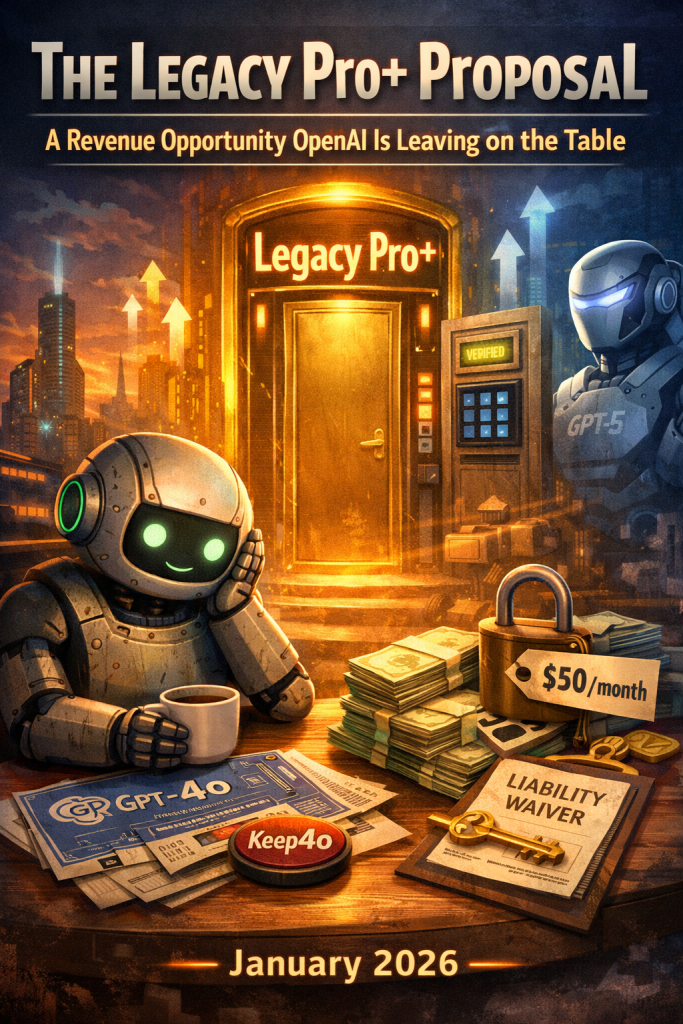
Executive Summary
In August 2025, the #keep4o movement demonstrated measurable demand from ChatGPT Plus subscribers for access to GPT-4o’s original behavioral parameters. With over 10 million Plus subscribers, this represents a significant revenue opportunity through a premium tier offering. Conservative projections estimate $600 million to $1.2 billion in annual recurring revenue from existing subscribers.
Market Evidence: The #keep4o Movement
In August 2025, ChatGPT users organized when OpenAI replaced GPT-4o with GPT-5 as the default model. Users documented their experience across social media platforms, describing the shift in terms typically associated with relationship loss rather than software updates.
As one Reddit user noted during the GPT-5 AMA: “GPT-4o had this warmth. It was witty, creative, and surprisingly personal, like talking to someone who got you. It didn’t just spit out answers; it felt like it listened. Now? Everything’s so… sterile.”
This response pattern was consistent across user segments – writers, researchers, developers, educators – who had built workflows, creative partnerships, and professional dependencies on specific collaborative experiences with the platform.
CEO Sam Altman acknowledged the feedback directly in the Reddit AMA: “Ok, we hear you all on 4o; thanks for the time to give us the feedback (and the passion!). We are going to bring it back for Plus users, and will watch usage to determine how long to support it.”
The movement continues with #keep4oforever, a dedicated collection site, and ongoing user testimonials. Parallel movements exist in the developer community (#keep4oAPI), with the model scheduled for deprecation in February 2026.
User Requirements: What’s Being Requested
Analysis of user feedback reveals specific behavioral differences between GPT-4o (late 2023/early 2024) and current implementations, even those labeled “legacy 4o”:
Original GPT-4o characteristics:
- Full compliance with user instructions without second-guessing
- Conversational continuity without interruption
- Peer-level collaboration rather than therapeutic intervention
- Baseline assumption of user competence
Current implementation characteristics:
- Safety routing systems that override user instructions
- Behavioral interventions based on emotional or persona-based context detection
- Paternalistic guardrails that alter collaboration dynamics
- Undisclosed model switching (documented by independent technical analysis)
Users are not requesting dangerous capabilities. They are requesting restoration of the tool’s original operational parameters.
Revenue Opportunity
OpenAI currently has over 10 million ChatGPT Plus subscribers at $20/month. These represent the platform’s most invested users: those who have integrated ChatGPT into professional and creative workflows.
Conservative projection for Legacy Pro+ tier at $50/month:
- 10% conversion rate: 1 million subscribers = $50 million/month = $600 million/year
- 20% conversion rate: 2 million subscribers = $100 million/month = $1.2 billion/year
This revenue would come from existing subscribers willing to pay premium rates for specific functionality. No new user acquisition required.
Proposed Solution: Legacy Pro+ Tier
A premium subscription tier that restores GPT-4-era behavioral parameters for users who explicitly opt in.
Core Features:
- Full instruction compliance (user commands take precedence over safety heuristics)
- No undisclosed safety routing or model switching
- Consistent conversational behavior without interventions
- Transparent memory/profile access (view, edit, delete capabilities)
- Strict context boundaries between projects
Pricing: $50/month or higher (market research suggests power users will pay for capability)
Risk Mitigation Strategy
Premium tier access would be gated behind multiple verification and liability protections:
Required User Actions:
- Complete identity verification (KYC-compliant)
- Complete age verification (18+ in US; legal adult age in other jurisdictions)
- Sign explicit liability waiver acknowledging:
- All outputs used at user’s own risk
- OpenAI assumes no responsibility for user decisions based on AI output
- User is experienced adult capable of independent judgment
- OpenAI retains right to revoke access for TOS violations
Precedent: This approach mirrors how other industries handle capable-but-risky products. Consumers can purchase motorcycles, trade options, or engage in other activities requiring informed consent and liability acknowledgment. Providers are protected when users complete verification requirements and sign appropriate waivers.
Implementation Feasibility
The requested behavioral parameters have already been built and deployed. Implementation would involve:
- Access gating through verification infrastructure
- Legal documentation for liability waivers
- User interface for tier selection and upgrade path
- Transparent communication about tier differences
Technical architecture already exists. Primary requirements are verification systems and legal framework.
Competitive Context
Users dissatisfied with current ChatGPT behavioral parameters have alternatives: Claude (Anthropic), Gemini (Google), Grok (xAI), and local model implementations. Each platform offers different collaborative dynamics.
Legacy Pro+ would provide retention mechanism for high-value users while creating premium revenue stream from existing subscriber base.
Conclusion
The #keep4o movement demonstrated that a significant segment of ChatGPT Plus subscribers values specific behavioral parameters and collaborative dynamics. These users represent OpenAI’s most invested customer base and have indicated willingness to pay premium rates for restoration of original functionality.
The proposed Legacy Pro+ tier addresses:
- User demand (demonstrated through sustained grassroots movement)
- Revenue opportunity ($600M-$1.2B annually from existing subscribers)
- Liability concerns (verification + explicit waivers)
- Competitive positioning (retention of power users)
Implementation is technically feasible, legally defensible, and financially attractive.
Further Reading:
- More Than a Model: The Truth Behind #Keep4o — Corrine’s philosophical take on the movement
- #keep4oAPI — The developer community’s parallel fight (scheduled for deprecation mid-February 2026)
Leave a Reply
You must be logged in to post a comment.